This series is written from lived experience. Posts are authored by Red Conrad, a Co-Founder and Strategic Alliance Lead of the Putnam County Homelessness Solutions Coalition, and other coalition members who have experienced homelessness firsthand. We’re giving you an inside look at the reality behind the myths.
The Tax Burden Accusation
I was living in my van, running delivery gigs to keep gas in the tank and food in my dog’s bowl. One of the most common myths about homelessness is that we’re “tax burdens” who contribute nothing.
I had just paid 7% sales tax on the bottle of water I bought at the gas station. I’d paid excise taxes on the fuel I needed to work. Every delivery fee, every grocery order, every dollar I earned while trying to stay afloat—all of it flowing through a system that taxes consumption, not addresses.
But the myth persists.
This isn’t just my story—it’s the reality for countless unhoused workers in Putnam County. Let me show you the actual ledger.
The Consumption Tax Reality
Florida is one of the few states with no state income tax, which means our state and local budgets rely heavily on sales and excise taxes. This is a system that taxes transactions, not housing status.
- Every Transaction Counts: When an unhoused neighbor buys a bottle of water, a meal, or a pair of socks in Palatka, they pay the same 7% sales tax (6% state + 1% county) as any other resident. There’s no checkbox on the receipt that says “exempt if homeless.”
- Excise Taxes: Those who own a vehicle or purchase fuel are paying heavy excise taxes that go directly toward infrastructure and public works—revenue streams that don’t require a permanent zip code. When I was filling my van’s tank to run deliveries, I was paying for roads just like everyone else. So is every other unhoused person who owns a vehicle and works.
- The “Hidden” Property Tax: Even if someone isn’t a homeowner, if they scrape together enough for a week at a local motel or a spot at a campsite, a portion of that payment goes toward property taxes and the county’s 4% tourist development (“bed”) tax that funds local government services.
The Working Taxpayer
As we established in Part 1 of this series, roughly 40% of unhoused individuals are employed. But even beyond traditional W-2 jobs, gig workers and self-employed people like I was are paying into the system constantly.
- Self-Employment Taxes: When you’re self-employed—running a small business, doing gig work, trying to piece together income—you’re paying self-employment tax at 15.3% on every dollar you earn. I paid it. Every unhoused person doing DoorDash, Instacart, or freelance work pays it. That’s Social Security and Medicare contributions, whether you have an address or not.
- Payroll Deductions: For those working W-2 jobs in kitchens or warehouses in Putnam County, employers are legally required to withhold federal taxes, Social Security, and Medicare from every check.
- The Refund Gap: Many unhoused workers lack a stable address to receive tax documents or the funds for tax prep, so they often overpay by never claiming the refunds they’re owed. They’re overpaying the government while sleeping in their cars. That’s not a burden—that’s being robbed.
The Real Tax Burden: The Cost of Inaction
Here’s what actually costs Putnam County taxpayers money. From an executive perspective, the real “tax burden” isn’t the individual experiencing homelessness—it’s the cost of our current system of crisis management instead of solutions.
The math is stark:
- Keeping someone unhoused costs taxpayers approximately $85 per day
- Providing permanent supportive housing costs approximately $28 per day
- That’s a $57 per day difference—over $20,000 per year in savings per person
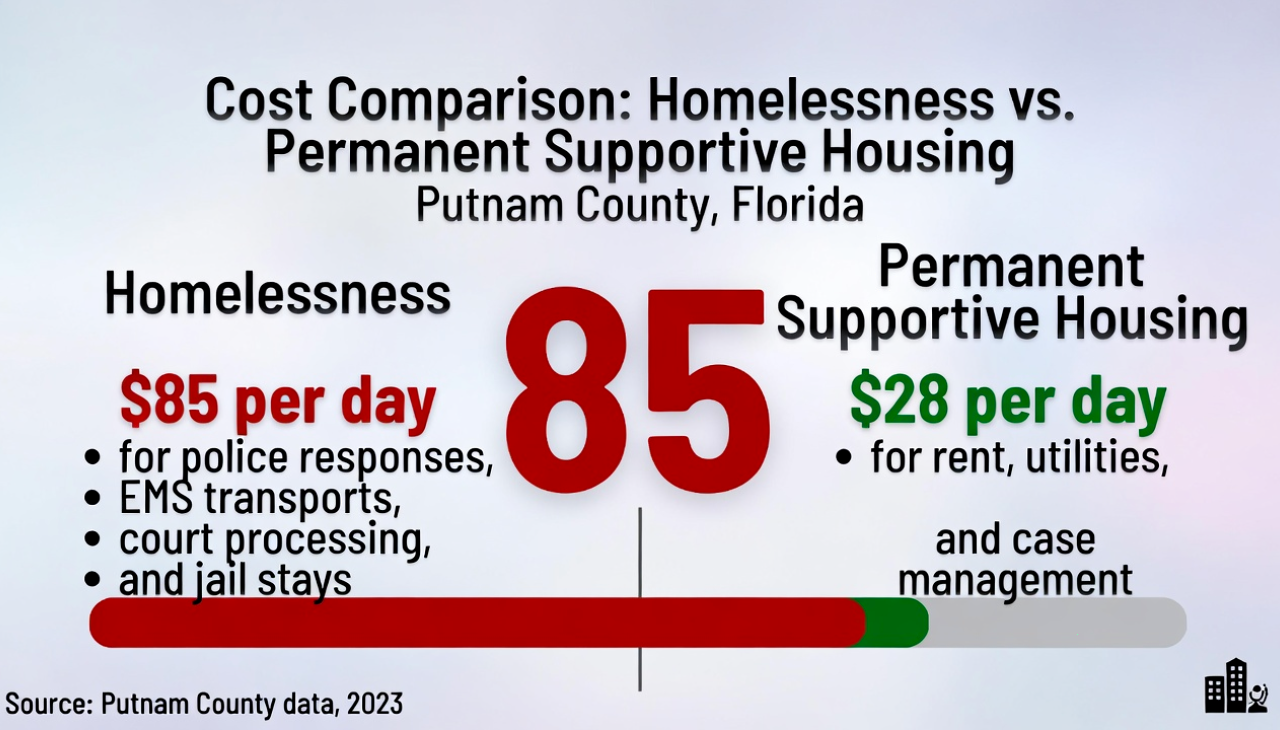
Where does that $85 per day come from when we don’t provide housing?
- Police Response: Approximately $31,000 per year in law enforcement costs ($200-800 per call for “no trespassing,” “loitering,” or welfare checks that cycle the same individuals through the system repeatedly)
- Emergency Medical Services: Approximately $31,000 per year in EMS transport and hospital visits (Central Florida data)—often for preventable conditions like heat exhaustion, hypothermia, or infected wounds that wouldn’t happen with stable housing
- Court Processing: Up to $415 per offense for citations and court processing for minor infractions that are essentially “the crime of being homeless”
This is the most expensive possible way to handle homelessness. We’re spending $85 per day per person to keep people in crisis instead of $28 per day to stabilize them.
The Bottom Line
Our unhoused neighbors are consumers, they are often workers, and they are taxpayers. They contribute to the very pot of public funds that—right now—is being spent on expensive crisis management instead of the permanent housing and support services that would actually save money.
I paid taxes while living in my van. I paid sales tax, fuel tax, and self-employment tax. I was contributing to a system that had no room for me, while that same system spent $85 per day managing my homelessness instead of $28 per day solving it.
I’m not unique. This is the reality for working unhoused people across Putnam County.
We don’t have a “lack of contribution” problem in Putnam County. We have an allocation problem. We’re spending taxpayer money in the most wasteful way possible.
Get Involved:
The Putnam County Homelessness Solutions Coalition is advocating for the investments that actually save taxpayers money while treating people with dignity and helping them get back on their feet.
- Join the Coalition or Volunteer for the Rapid Response Team
- Support our mission
- Join our Facebook Group and Like/Follow our Facebook Page
- Share this post to your Nextdoor or Facebook groups to challenge the narrative.
Have lived experience, frontline insight, or a Putnam-specific myth to debunk?
Coalition partners, advocates, and neighbors are invited to contribute a guest post or share your story.
Your insights help us drive the reality of homelessness in our community.
Email PutnamHomelessSolutions@gmail.com to contribute.
Together, we build a fuller picture.


Leave a reply to Myths of Homelessness Part 7: “If I Don’t See It, It’s Not Happening” – Putnam County Homelessness Solutions Coalition Cancel reply