Category: Insights

  • Myths of Homelessness Part 4: “It’s Just a Drug or Mental Health Problem”

    Lived Experience Perspective

    This series is written from lived experience. Posts are authored by Red Conrad, a Co-Founder and Strategic Alliance Lead of the Putnam County Homelessness Solutions Coalition, and other coalition members who have experienced homelessness firsthand. We’re giving you an inside look at the reality behind the myths.

    This post includes testimony from Beth (@voiceofbeth on Instagram/Threads). Her complete testimony is the ‘Voices from the Street // Beth: Sober, Employable, and Breaking Every Stereotype’, used with permission.

    Myths of Homelessness Table of Contents 

    The Diagnosis That Followed Me

    I was diagnosed with depression at 16, then again at 25. For years, I managed it. I had stability, routines, medication, a life that worked. I wasn’t “cured,” but I was functional.

    Then I lost my wife to cancer. Then I lost my home. Then I was living in my van.*¹

    My depression didn’t cause my homelessness—but homelessness nearly destroyed me with it.

    In Part 2, I shared how my depression—which I’d managed for years—became overwhelming once I lost my wife and my home. That’s the pattern: homelessness doesn’t cause mental health issues, but it makes existing conditions exponentially worse.

    The Myth vs. The Reality

    One of the most persistent myths about homelessness is that it’s fundamentally a “drug or mental health problem”—that if we just “fix” people’s addiction or mental illness, homelessness will solve itself.

    This gets the causation backwards.

    While substance use and mental health challenges are present in the homeless population, they are frequently the result of the trauma of displacement, not the initial cause. In Putnam County, the primary drivers of homelessness are economic: a lack of affordable housing and wages that don’t cover rent. The mental health crisis and substance use often come after someone loses their housing, not before.

    When Survival Makes You Sick

    I had my depression under control—until I didn’t have a place to live. Then everything that kept me stable disappeared.

    The constant hypervigilance. Wondering where I could park each night without getting “the knock” from police. Where I could park during the day between gigs without being told to move. The mental energy spent trying to look “normal” so potential employers wouldn’t realize I was living in my van. The days I didn’t know if I could keep going.

    Living on the street in Florida means extreme sleep deprivation, physical danger, and constant “fight or flight” stress. Your nervous system never gets to rest. You can’t sleep deeply because you need to stay alert. You can’t plan for tomorrow because you’re barely surviving today.

    This is when people turn to substances—not because they’re “addicts” who caused their own homelessness, but because they’re trying to survive it. Some use stimulants to stay awake at night for safety. Others use alcohol or other substances to numb the physical pain of sleeping on concrete, or to quiet the anxiety long enough to get a few hours of rest.

    I watched it happen. People who weren’t using before they became homeless, self-medicating just to endure another day.

    Beth, who shares her experience on Instagram as @voiceofbeth, puts it bluntly: “Not everybody’s an addict. I, for one, am stone cold sober. I’m quite employable. I was leaving a bad situation and I thought that homelessness would be better for my mental health, and it is.” But she also describes how easy it is to fall into substance use when you’re stuck without resources or transportation: “Eventually, after a while of being homeless, you can veer off into that real easy because there’s not a lot you can do…You might as well smoke a bowl. You might as well, you know, whatever, smoke meth or whatever you’re doing, drink a beer.” It’s not that homeless people are addicts—it’s that homelessness creates the conditions where substance use becomes a survival mechanism.

    The Impossible Catch-22

    Here’s what people don’t understand about the “just get treatment” argument: You cannot effectively treat a clinical diagnosis while someone is living in a tent or a vehicle.

    I had depression before I was homeless. I knew what treatment looked like. But try accessing mental health care when:

    • You don’t have a stable address for appointment reminders
    • You don’t have a shower to show up clean and “presentable”
    • You don’t have a guarantee your car won’t be towed while you’re in the waiting room
    • You’re spending 100% of your mental energy on immediate survival

    The system says “get stable, then we’ll help you with housing.” But you can’t get stable without housing. That’s not a pathway—that’s a trap.

    Stability is the prerequisite for recovery, not the reward for it.

    The Economic Reality

    The majority of people experiencing homelessness in Putnam County are “economically homeless”—families and individuals who are one car breakdown or medical bill away from the street, regardless of their mental health status.

    I had a business. I had skills. I had work ethic. What I didn’t have was affordable housing in a county where market-rate rents average $1,500 and wages haven’t kept pace. When crisis hit, there was no safety net.

    Using addiction or mental illness as an excuse to withhold housing is backwards. If we want people to be healthy and sober, we have to provide the foundation—stable housing—that makes health possible.

    The Operational Logic

    In business, if a piece of equipment consistently fails, a poor manager blames the “quality” of the machine. A strategic leader looks at the operating environment. If you run a machine at 110% capacity in a room with no ventilation, it will break.

    Our unhoused neighbors aren’t “broken people.” They’re human beings trying to function in an environment designed to break them. Sleep deprivation, constant stress, no medical care, no stability—this environment would damage anyone’s mental health.

    The Coalition’s Approach

    The Putnam County Homelessness Solutions Coalition advocates for Housing First models.

    Get people housed first. Then provide support services. Then watch recovery become possible.

    This isn’t enabling—it’s strategic. You can’t address mental health or addiction while someone is fighting for survival on the street. You provide the stable foundation, then you build the supports.

    This isn’t just compassionate. It’s effective. And it costs taxpayers less than our current crisis-management approach of cycling people through emergency rooms, jails, and police calls.*²

    Get Involved:

    The answer to Putnam County’s homelessness crisis isn’t more judgment about addiction or mental health. It’s more housing.

    Join the Coalition or Volunteer for the Rapid Response Team

    Support our mission 

    Join our Facebook Group and Like/Follow our Facebook Page

    Share this post to your Nextdoor or Facebook groups to challenge the narrative.

    References:


    Share Your Story

    Have lived experience, frontline insight, or a Putnam-specific myth to debunk?
    Coalition partners, advocates, and neighbors are invited to contribute a guest post or share your story for the ‘Voices From The Street’ series.

    Your insights help us drive the reality of homelessness in our community.
    Email PutnamHomelessSolutions@gmail.com to contribute.
    Together, we build a fuller picture.


    Guest Voice: Beth shares her experience of homelessness across multiple states on Threads and Instagram as @voiceofbeth. Her full testimony is ‘Voices from the Street // Beth: Sober, Employable, and Breaking Every Stereotype

  • Myths of Homelessness Part 3: “They Don’t Contribute to the Tax Base”

    Lived Experience Perspective

    This series is written from lived experience. Posts are authored by Red Conrad, a Co-Founder and Strategic Alliance Lead of the Putnam County Homelessness Solutions Coalition, and other coalition members who have experienced homelessness firsthand. We’re giving you an inside look at the reality behind the myths.

    Myths of Homelessness Table of Contents

    The Tax Burden Accusation

    I was living in my van, running delivery gigs to keep gas in the tank and food in my dog’s bowl. One of the most common myths about homelessness is that we’re “tax burdens” who contribute nothing.

    I had just paid 7% sales tax on the bottle of water I bought at the gas station. I’d paid excise taxes on the fuel I needed to work. Every delivery fee, every grocery order, every dollar I earned while trying to stay afloat—all of it flowing through a system that taxes consumption, not addresses.

    But the myth persists.

    This isn’t just my story—it’s the reality for countless unhoused workers in Putnam County. Let me show you the actual ledger.

    The Consumption Tax Reality

    Florida is one of the few states with no state income tax, which means our state and local budgets rely heavily on sales and excise taxes. This is a system that taxes transactions, not housing status.

    • Every Transaction Counts: When an unhoused neighbor buys a bottle of water, a meal, or a pair of socks in Palatka, they pay the same 7% sales tax (6% state + 1% county) as any other resident. There’s no checkbox on the receipt that says “exempt if homeless.”
    • Excise Taxes: Those who own a vehicle or purchase fuel are paying heavy excise taxes that go directly toward infrastructure and public works—revenue streams that don’t require a permanent zip code. When I was filling my van’s tank to run deliveries, I was paying for roads just like everyone else. So is every other unhoused person who owns a vehicle and works.
    • The “Hidden” Property Tax: Even if someone isn’t a homeowner, if they scrape together enough for a week at a local motel or a spot at a campsite, a portion of that payment goes toward property taxes and the county’s 4% tourist development (“bed”) tax that funds local government services.

    The Working Taxpayer

    As we established in Part 1 of this series, roughly 40% of unhoused individuals are employed. But even beyond traditional W-2 jobs, gig workers and self-employed people like I was are paying into the system constantly.

    • Self-Employment Taxes: When you’re self-employed—running a small business, doing gig work, trying to piece together income—you’re paying self-employment tax at 15.3% on every dollar you earn. I paid it. Every unhoused person doing DoorDash, Instacart, or freelance work pays it. That’s Social Security and Medicare contributions, whether you have an address or not.
    • Payroll Deductions: For those working W-2 jobs in kitchens or warehouses in Putnam County, employers are legally required to withhold federal taxes, Social Security, and Medicare from every check.
    • The Refund Gap: Many unhoused workers lack a stable address to receive tax documents or the funds for tax prep, so they often overpay by never claiming the refunds they’re owed. They’re overpaying the government while sleeping in their cars. That’s not a burden—that’s being robbed.

    The Real Tax Burden: The Cost of Inaction

    Here’s what actually costs Putnam County taxpayers money. From an executive perspective, the real “tax burden” isn’t the individual experiencing homelessness—it’s the cost of our current system of crisis management instead of solutions.

    The math is stark:

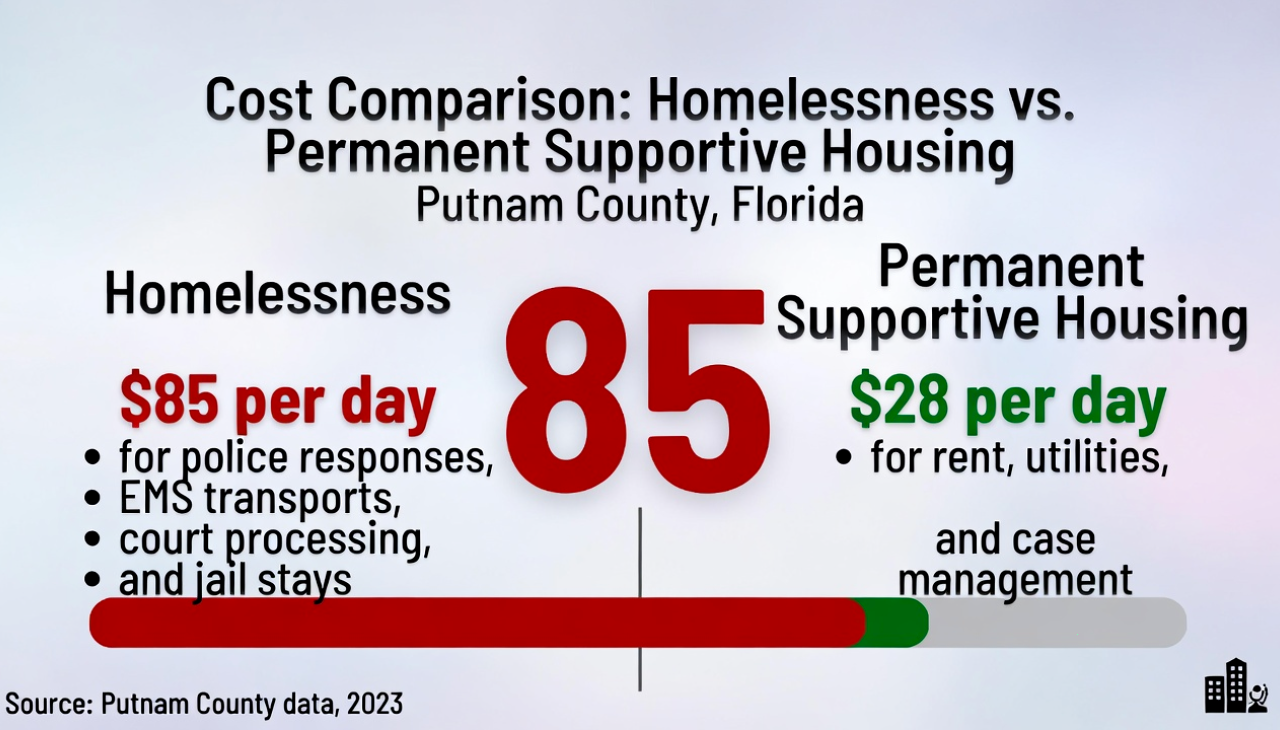
    • Keeping someone unhoused costs taxpayers approximately $85 per day
    • Providing permanent supportive housing costs approximately $28 per day
    • That’s a $57 per day differenceover $20,000 per year in savings per person

    Where does that $85 per day come from when we don’t provide housing?

    1. Police Response: Approximately $31,000 per year in law enforcement costs ($200-800 per call for “no trespassing,” “loitering,” or welfare checks that cycle the same individuals through the system repeatedly)
    2. Emergency Medical Services: Approximately $31,000 per year in EMS transport and hospital visits (Central Florida data)—often for preventable conditions like heat exhaustion, hypothermia, or infected wounds that wouldn’t happen with stable housing
    3. Court Processing: Up to $415 per offense for citations and court processing for minor infractions that are essentially “the crime of being homeless”

    This is the most expensive possible way to handle homelessness. We’re spending $85 per day per person to keep people in crisis instead of $28 per day to stabilize them.

    The Bottom Line

    Our unhoused neighbors are consumers, they are often workers, and they are taxpayers. They contribute to the very pot of public funds that—right now—is being spent on expensive crisis management instead of the permanent housing and support services that would actually save money.

    I paid taxes while living in my van. I paid sales tax, fuel tax, and self-employment tax. I was contributing to a system that had no room for me, while that same system spent $85 per day managing my homelessness instead of $28 per day solving it.

    I’m not unique. This is the reality for working unhoused people across Putnam County.

    We don’t have a “lack of contribution” problem in Putnam County. We have an allocation problem. We’re spending taxpayer money in the most wasteful way possible.

    Get Involved:

    The Putnam County Homelessness Solutions Coalition is advocating for the investments that actually save taxpayers money while treating people with dignity and helping them get back on their feet.


    Share Your Story

    Have lived experience, frontline insight, or a Putnam-specific myth to debunk?
    Coalition partners, advocates, and neighbors are invited to contribute a guest post or share your story.

    Your insights help us drive the reality of homelessness in our community.
    Email PutnamHomelessSolutions@gmail.com to contribute.
    Together, we build a fuller picture.

  • Myths of Homelessness Part 2: “They Choose to Live This Way”

    Lived Experience Perspective

    This series is written from lived experience. Posts are authored by Red Conrad, a Co-Founder and the Strategic Alliance Lead of the Putnam County Homelessness Solutions Coalition, and other coalition members who have experienced homelessness firsthand. We’re giving you an inside look at the reality behind the myths.

    This post includes testimony from Beth (@voiceofbeth on Instagram/Threads). Her complete testimony is the ‘Voices from the Street // Beth: Sober, Employable, and Breaking Every Stereotype’, used with permission.

    Myths of Homelessness Table of Contents 

    The Cruelest Myth

    I’ve heard people say that “people choose to be homeless.” Let me explain what that “choice” actually looked like for me, as someone with lived experience of homelessness, and for many others who’ve shared their similar stories with our coalition.

    I lost my wife to cancer. The grief locked me away—clinically depressed, unable to leave the house for anything beyond survival. I crashed my business not through laziness but through paralysis: I could handle repeat customers who already knew me, but every new phone call felt insurmountable. I moved friends in who had nowhere else to go, hoping they’d help me stay afloat. Instead, on a single day while I was out working, I came home to find I’d been robbed and my property destroyed. That was day one of living in my van with my dog.

    As we discussed in Myth Part 1, 40% of unhoused people are employed. So the question isn’t ‘Why don’t they just get a job?’—it’s ‘Why does having a job still leave them homeless?’ The answer: Because when you’re fighting depression while living in a van, even having work doesn’t create the stability you need to escape.

    That’s not a “choice.” That’s a cascade of loss that moves faster than any human can recover from.

    And yet people still ask “Why don’t you just try harder?” As if depression, grief, and systemic barriers could be overcome through sheer willpower. As if the problem was my work ethic, not the fact that I’d lost everything in a matter of weeks. I was trying—every single day. I was running delivery gigs while living in my van. I was trying to rebuild my business from a parking lot. But “trying harder” doesn’t create affordable housing. It doesn’t erase grief. It doesn’t fix a broken system. The bootstrap mentality assumes everyone starts with boots—and a stable place to put them on.

    The myth that people “choose” homelessness suggests that living in a tent in the Florida humidity, facing constant threat of theft, losing access to basic rights like voting (no address for registration) or even standing in a public park without being told to move along, is somehow a “preferable” lifestyle. What people mistake for “choice” is actually the absence of viable exits.

    Beth, who shares her experience as @voiceofbeth on Instagram, made what looked like a “choice” to become homeless: “I was leaving a bad situation and I thought that homelessness would be better for my mental health, and it is.” But that’s not choosing homelessness as a preference—that’s choosing homelessness as the least bad option when you’re fleeing danger. When the alternative is staying in an abusive situation, living in your car or a tent isn’t a “lifestyle choice”—it’s survival.

    The “Service-Resistant” Fallacy

    In Putnam County, we often hear that people are “service-resistant”—that they “refuse help.” But we need to ask: What is the actual quality of the “help” being offered?

    • The Vanishing Safety Net: Palatka’s only overnight shelter closed in November 2025 due to city zoning and code violations at its church-based location, leaving dozens without any local alternative. The “choice” for many wasn’t between a bed and a tent; it was between a tent, the back of a car, or a jail cell. There was no “right” option—and no replacement overnight facility has opened since.
    • The Impossible Rules: With our local shelter gone, the nearest alternatives often require: no pets, mandatory religious services, or a 30-day substance-free verification. For someone with an untreated mental health crisis or someone whose only companion is the dog that’s kept them safe and gives them purpose to keep living, “refusing help” isn’t about wanting to be homeless—it’s about refusing to surrender the last shred of stability or dignity you have left. When your choice is between a shelter bed and abandoning the dog that watched over you in that van on your first night homeless, what would you choose?
    • The Bureaucratic Maze: I remember sitting in a library trying to fill out a housing application while simultaneously calculating whether I had enough gas to make it to the free meal site and back to where I was sleeping. My brain kept choosing the gas calculation. Every. Single. Time. That’s not laziness—that’s survival mode.

    The Neuroscience of Survival

    When you’re unhoused, your brain shifts into what researchers call “Survival Mode.” Your prefrontal cortex—the part of the brain used for long-term planning, budgeting, and career moves—effectively shuts down to prioritize immediate safety.

    • Decision Fatigue: When every ounce of energy is spent finding water, avoiding the police, and keeping your gear dry, you don’t have the bandwidth to navigate complex social service systems that take months to yield results. You can’t “plan your way out” when your brain is wired for “survive today.”
    • The “I’m Fine” Defense: After being turned away enough times—wrong zip code, missed a deadline, didn’t have the right paperwork—it becomes psychologically easier to say “I prefer it out here” than to keep admitting the system has no space for you. The “choice” becomes a defense mechanism against the repeated trauma of rejection.

    The Operational Reality

    In Putnam County, poverty affects about 20.7% of residents (per recent Census estimates), and unemployment hovered around 5.7% in late 2025 (higher than Florida’s statewide average). Statewide, Florida faces a massive affordable housing shortage, with only 26 rental homes affordable and available for every 100 extremely low-income households, and a need for over 411,000 more such units. When the “exit ramp” out of homelessness requires a $3,000+ down payment (first month, last month, and security deposit) plus a 650+ credit score, the path out is effectively blocked for someone making minimum wage—especially someone whose credit was destroyed during the crisis that made them homeless in the first place.

    Staying on the street isn’t a choice; it’s a consequence of a market where the bottom rungs of the ladder have been removed entirely.

    Break the Stigma:

    The Putnam County Homelessness Solutions Coalition is building the exit ramps that don’t currently exist. We advocate for Housing First solutions and programs that meet people where they are, rather than demanding they solve their own crisis before they deserve help.

    Share Your Story

    Have lived experience, frontline insight, or a Putnam-specific myth to debunk?
    Coalition partners, advocates, and neighbors are invited to contribute a guest post or share your story for the ‘Voices From The Street’ series.

    Your insights help us drive the reality of homelessness in our community.
    Email PutnamHomelessSolutions@gmail.com to contribute.
    Together, we build a fuller picture.


    Guest Voice: Beth shares her experience of homelessness across multiple states on Threads and Instagram as @voiceofbeth. Her full testimony is ‘Voices from the Street // Beth: Sober, Employable, and Breaking Every Stereotype

  • Voices From The Street // Beth: Sober, Employable, and Breaking Every Stereotype

    Welcome to Voices From The Street, a new sub-series under Myths of Homelessness. Here, we amplify real stories from people with lived experience—raw, unfiltered insights that challenge stereotypes and humanize the crisis. We start with Beth (@voiceofbeth on Instagram/Threads), who shared this powerful audio message. Her experiences across multiple cities show homelessness isn’t defined by addiction, low intelligence, or pests—it’s about survival, resilience, and systemic gaps.

    Follow Beth on Instagram and Threads

    If you found this post from links in the Myths of Homelessness series Parts 2, 4, 7, 8, 12 (as they publish), be sure to give her a follow. If you have a story to share for the ‘Voices From The Street’ sub series of the ‘Myths of Homelessness’ series, you can opt to remain anonymous, send your submission to PutnamHomelessSolutions@gmail.com

    Key Insights from Beth

    Not Everyone Is an Addict

    Beth is clear: “I, for one, am stone cold sober. I’m quite employable… I was leaving a bad situation and I thought that homelessness would be better for my mental health, and it is. So not everybody’s an addict.”

    She explains how addiction can emerge later as a response to isolation and lack of options: “Eventually… you can veer off into that real easy because there’s not a lot you can do… you’re stuck… you might as well smoke a bowl… drink a beer.”

    This aligns with research showing substance use is frequently a consequence of homelessness rather than the sole cause—many people begin or increase use as a way to cope with trauma, boredom, and limited access to support.

    Intelligence, Creativity, and Resourcefulness

    “A lot of people who have never been homeless equate homelessness with a lack of intelligence… the people that I have found to be homeless, they are some of the most amazing people… some of the most creative, some of the most brilliant…”

    She shares the story of Shawn and Becky in the Biloxi/Gulfport area:

    “It was a trash pile when they started… By the time this dude was done… it had like a little pathway… tiny sticks lining the pathway… old basin as handwashing station… these guys went above and beyond.”

    Beth observes that many unhoused people demonstrate exceptional problem-solving and adaptability, often struggling to fit rigid social or work structures rather than lacking ability.

    The Bed Bugs Myth and Shelter Realities

    “Not all homeless people have bed bugs… Campers never have bed bugs because… bed bugs cannot survive… sunlight.”

    In contrast, she describes severe infestations in shelters and low-budget hotels: “this place [in Miami]… was overrun with bed bugs… even in their… clothes closet… supposed to have been heat treated… thousands of dead bed bugs.”

    This highlights a key reason many avoid shelters: fear of pests, strict rules (tiny lockers, item limits), and loss of possessions—especially for newly unhoused people who haven’t yet “gone through that purge… death of materialism.”

    Dehumanization and Basic Dignity

    “If you’ve never been homeless… you don’t know what it’s like when you can’t even use a restroom… people are mocking you… shitting behind a bush. Well, if you treated me like a human, I would have just used the toilet.”

    Beth emphasizes that small acts of dignity (access to bathrooms, respect, resources) make an enormous difference.

    Connecting to R.I.S.E. in Putnam County

    Beth’s story underscores why structured, dignified solutions matter: safe bathrooms, case management to prevent isolation spirals, skills training to support employable people, and a welcoming hub that honors creativity and resilience. Florida’s 2025 Council on Homelessness Report shows real progress—9.13% statewide drop in homelessness and 19.1% decline in unsheltered cases through targeted partnerships and coordination. Our Program is built on the same principle: local, accessible resources that help neighbors rebuild stability in their own community.


    Transcription (Edited Lightly for Clarity/Flow)

    [0:00] Hey, Red Conrad. This is for your myths of homelessness uh for the Putnam homeless solutions blog, vlog, whatever you’re doing over there. First of all, I want to say hi. I’m Beth from @voiceofbeth on Instagram. There are a lot of myths about the homeless. The one that really comes to mind for me personally is that everybody who’s homeless is an addict or like a prostitute or something like that. I, for one, am stone cold sober. I’m quite employable. You know, I’m just—I was leaving a bad situation and I thought that homelessness would be better for my mental health, and it is. So, not everybody’s an addict. Eventually, after a while of being homeless, you can veer off into that real easy because there’s not a lot you can do. Especially like if you don’t have access to public transportation, if you don’t have access to resources, if you’re just stuck homeless up in a mountain town, you’re screwed. You might as well smoke a bowl. You might as well, you know, whatever, smoke meth or whatever you’re doing, drink a beer. So not every homeless person is an addict.

    [1:39] Also, a lot of people who have never been homeless equate homelessness with a lack of intelligence. In my experience—and I’ve been homeless in Dallas, I’ve been homeless in Miami, I’ve been homeless in Biloxi, I’ve been homeless in Gulfport. I’m now homeless in Oregon—the people that I have found to be homeless, they are some of the most amazing people that you will meet. Now, are there some jerks and stuff in there? Some real scary, creepy people? Yes. Is it the majority? Not necessarily. It depends on your area. It depends on who your little crowd is. I’ve met some of the most creative, some of the most brilliant homeless people that you wouldn’t even believe it.

    [2:58] Specifically, there was this one couple, Shawn and Becky, that I met in the Biloxi Gulfport area. They—just like every other homeless person—they didn’t have anything to do all day. And, you know, you don’t just stay up on your phone. You’re on your phone a little bit, but you don’t stay up on your phone because you don’t know when you’re going to charge next, you know, unless you have a system down. So, they spent their time—Shawn specifically—built… It was a trash pile when they started, right? By the time this dude was done with it, this thing was amazing. Okay, it had like a little pathway. Little tiny sticks were lining the pathway. Like he used this old basin and like that was the handwashing station. Like these guys went above and beyond and they are only one example of so many that I have found across the nation that were just brilliant. Some of them painted shells to earn money. Some of them played music and busked. You know, they’re… Homeless people—when you see a homeless person, I can almost guarantee you they have a higher than average IQ. And that’s why they’re homeless, too, is because they can’t exist within a lot of the social structures we have today within working and stuff like that. Maybe they have a slight mental illness, but it’s manageable. You know what I mean? Like there—people just… on the homeless. I’m never going to understand it.

    [4:21] Another myth is that homeless people have bed bugs. They do not. If you’re looking for bed bugs, they can have them, but they don’t come from campers. Like there’s different tiers of homelessness. And one tier is like where you have a tent set up in some wilderness part of an urban area or even a country area, a rural area. And those are like campers, right? The campers never have bed bugs because the bed bugs cannot survive in any type of sunlight. Now, if you live in a shelter—if you… there was a shelter I stayed at in Miami, I think called Chapman, I believe it’s 1550 North Miami Avenue or something like that. Anyway, this place was overrun with bed bugs, okay? Overrun. It was even in their stores of like they had like a clothes closet and this was supposed to have been heat treated, right? And it was supposed to have been sanitized or whatever they do with their processes there. It was not. Like I—my ex, I was with a dude at that time and my ex pulled out one of those braided belts from like the early 90s late 80s and it was just thousands of dead bed bugs in there. It was so gross. There was just bed bugs everywhere. So like shelters might have bed bugs. Campers don’t have them. Low budget hotels that you can stay pay by the week—they were in a Dallas hotel that I stayed at. It was so horrible. The bed bugs are just horrendous. So that’s another myth. Not all homeless people have bed bugs.

    [5:45] Okay, they’re not addicts. They’re not stupid. They don’t have bed bugs. Not all of them anyway. And I’m trying to think what else do they have? What other myths are there? There’s so friggin many. You can’t just go to a shelter. And it’s not just about the lack of beds and funding. There’s a lot of things like you’re only allowed so many items. In some shelters you only have a teeny tiny locker. And if you just are newly homeless, you have a ton of stuff still. You haven’t gone through that purge of items since you haven’t gone through that death of materialism yet. So there’s a lot, there’s a lot of myths. If I think of more, Red Conrad, I will definitely send you some. I wish you well on your mission. I know you deserve it. I like to see these homeless organizations being run by somebody who actually was homeless. You know, I mean, even if you haven’t been, it’s good to have a heart for the homeless, but at the same time, like, if you’ve never been homeless, you don’t know what it’s like. You don’t know what it’s like when you can’t even use a restroom, you know? And like, people are mocking you for seeing you drive down the side of the road and you’re shitting behind a bush. Well, if you treated me like a human, I would have just used the toilet. You know what I mean? So, anyway, bye, Red Conrad. Edit this video how you need to. I hope you have a great rest of your day.

    Share Your Story

    Have lived experience, frontline insight, or a Putnam-specific myth to debunk? Coalition partners, advocates, and neighbors are invited to contribute a guest post or share your story to the Voices From The Street series; you can opt to remain anonymous.

    Your insights help us drive the reality of homelessness in our community. Email PutnamHomelessSolutions@gmail.com to contribute. Together, we build a fuller picture.

  • Myths of Homelessness Part 1: “They Just Need to Get a Job”

    Lived Experience Perspective

    This series is written from lived experience. Posts are authored by Red Conrad, a Co-Founder and Strategic Alliance Lead of the Putnam County Homelessness Solutions Coalition, and other coalition members who have experienced homelessness firsthand. We’re giving you an inside look at the reality behind the myths.

    Myths of Homelessness Table of Contents 

    The Boardroom vs. The Street

    As someone who spent years as a VP of Operations and running my own service businesses, I’ve seen the world through the lens of spreadsheets, P&L statements, and hiring cycles.

    But as someone who was homeless myself before co-founding the Putnam County Homelessness Solutions Coalition, I’ve also seen the world from the pavement—right here in rural Putnam County, Florida, a place where poverty affects 23.9% of residents and the unemployment rate sits at 6.3%—higher than Florida’s statewide average of 4.2%. I’ve walked those streets myself during tough times, experiencing firsthand the exhaustion of trying to hold down work while sleeping in a vehicle or tent, constantly worrying about where my next meal or shower would come from. That lived experience drives every bit of our coalition’s work.

    The most common “solution” I hear from well-intentioned people is simple: “They just need to get a job.” It’s logical, but it collapses under scrutiny. Here’s why that “simple” solution is a logistical nightmare, especially in a place like Putnam.

    The Logistics of the Impossible

    In the professional world, we talk about “barriers to entry.” For our unhoused neighbors in Putnam, those barriers are often insurmountable without a front door:

    • The Paperwork Trap: Federal law (I-9 requirements) requires valid ID and social security cards to start a job. If your bag is stolen during a camp sweep—as happened to dozens when Palatka’s only overnight shelter closed last fall—you’re effectively “un-hireable” until you spend weeks navigating a bureaucratic maze to replace them, with no money, no transportation, and limited resources in our spread-out rural county.
    • The Address Filter: Most HR software automatically flags applications without a physical residential address. Before a hiring manager even sees your skills, the system has already discarded you. In rural Putnam County, where over 40% of renter households are cost-burdened—spending more than 40% of their income on housing—finding stable housing becomes nearly impossible without steady employment, creating an impossible catch-22.
    • The Hygiene Hurdle: Try staying “office ready” or even “manual labor ready” when you have no place to shower, iron a shirt, or even store your work boots safely overnight. With public facilities scarce and transportation limited, basic upkeep becomes a daily battle.

    The Invisible Workforce: The “Double Life”

    Here is the reality that many people miss: Many of our homeless neighbors in Putnam County already have jobs. They are the “Invisible Workforce”—the person stocking the shelves at 3 AM or the prep cook making your lunch. In fact, national trends show up to 40% of unhoused individuals are employed, and local anecdotes from our coalition partners confirm this pattern here. Because of the stigma I’ve seen firsthand in the business world—and felt myself when I was in their shoes—they live a high-stakes double life:

    • The Silence: They don’t talk about their “weekend” because their weekend was spent moving their car every few hours to avoid a trespass notice—or relocating after the recent shelter shutdown left dozens without options.
    • The Hygiene Hustle: They use gym memberships or gas station sinks to stay professional because they know the moment a boss finds out they are unhoused, they become a “liability” in the eyes of HR.
    • The Constant Friction: There is nothing less “operationally efficient” than a human being forced to spend 40% of their mental energy just pretending they have a home to go back to, all while navigating Putnam’s limited public transit and rural isolation.

    The Bottom Line

    Employment is a tool, but a tool is useless if you have nowhere to store it and no foundation to stand on while using it. We have people working 40 hours a week in our county who still cannot save enough for a security deposit and first month’s rent—especially with market-rate rents averaging around $1,500 monthly (even HUD’s “fair market rent” for a two-bedroom is $996), far outpacing wages in our service-heavy economy. Add in that 28% of children here live in poverty, and the cycle deepens.

    We need to stop telling people to “get to work” and start building the infrastructure that makes keeping a job possible. Housing First isn’t a handout; it’s the only logical starting point for a stable workforce—particularly after events like the Palatka shelter closure highlight how fragile our local support systems are.

    Get Involved:

    The Putnam County Homelessness Solutions Coalition is working to remove these barriers—from ID recovery to hygiene resources and advocating for permanent shelters.

    Help us build a stronger, more stable community.

    Follow this series: Over the coming weeks, we’ll debunk more myths—from “they choose to live this way” to “it’s too expensive to fix.” Each post draws from lived experience and local data to challenge the narrative around homelessness in Putnam County.

    Share Your Story

    Have lived experience, frontline insight, or a Putnam-specific myth to debunk?
    Coalition partners, advocates, and neighbors are invited to contribute a guest post or share your story.

    Your insights help us drive the reality of homelessness in our community.
    Email PutnamHomelessSolutions@gmail.com to contribute.
    Together, we build a fuller picture.